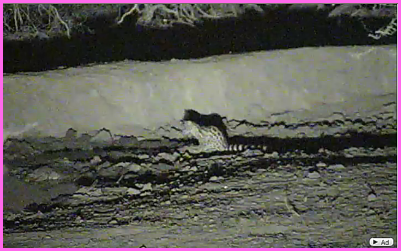
 GenetsGenets (pronounced /ˈdʒɛnɪts or dʒəˈnɛts/) are Old World mammals from the order Carnivora, suborder Feliformia, family Viverridae, and subfamily Viverrinae. They are related to civets, linsangs, fossa, and mongooses.[1] The common genet is the only viverrid present in Portugal.[2] Almost all species are contained within the genus Genetta, although the Aquatic Genet is sometimes housed in its own genus Osbornictis Genets are feliforms, and are related to cats. Most of them have spotted coats, long, banded tails, small heads, and large ears. They are able to move through any opening that their head can fit through.[1] Like civets, genets have strong musk glands, located by the anus, which are used for territorial, sexual and social purposes.[1][3] Genets are highly agile creatures, with quick reflexes and exceptional climbing skills, and are the only viverrids that are able to stand bipedally. They are able to walk, trot, run, climb up and down trees, and jump.[4] They are nocturnal and solitary, but some pairs and family groups are occasionally seen.[5] Males have been found to be more active than females at night because of their greater size, which indicates that males have greater energy requirements to satisfy their physiological needs. Females typically weigh less, and they have been found to be less active overall. Females' home ranges are also smaller than males'.[6] The mean annual home range of the common genet is 113 hectares (279 acres) for males and 72 hectares (178 acres) for females.[7] While males have larger home ranges in all seasons, the differences between male and females territories are most significant during the winter.[7] Genets possess extremely long tails, typically around one to one and a half times the length of their bodies. Their bodies are typically 16.9 to 22.9 inches long, while their tails are approximately 15.4-20.9 inches long.[1] These longs tails provide a highly effective counterweight that enables them to easily maintain balance as they leap from tree limb to tree limb. However, the length of genets' tails does not necessarily correspond to them inhabiting a more woody habitat.[8] They are not strictly terrestrial, and spend much of their time in trees.[9] Genets have semi-retractable claws, which they use for climbing and holding prey, but not for fighting.[3] Genets can move their eyes within their sockets, but eye mobility is limited; head movement is required.[10] Their ears can move via the pinna in order to locate sounds. The nose has a dual function, both olfactory and tactile perception. Smelling is aided by the rhinarium, utilized in many other mammals.[8] Adult genets typically weigh around 2.2 to 6.6 pounds, with an average weight of 4.4 pounds.[11] [edit] HabitatAll live exclusively in Africa except for the widespread Common Genet (Genetta genetta), which can be found in Northwest Africa and Southwestern Europe, parts of the Middle East, and the Balearic Islands.[12] Habitat tolerance varies widely between species as different species prefer woodlands, savannas, and forests.[9] They prefer to live in areas with dense vegetation, such as bushes, thickets, and evergreen oak forests.[13] Genets also prefer areas with high temperatures and low rainfall.[2] It has been found that females prefer thickets, while males use trees more than females.[14] Because of their solitary natures, genets each tend to have their own territories; however, the male and female home ranges may overlap.[11] The common genet and the wood mice share the same habitats and niches, specifically Mediterranean forests.[15] For this reason, they have physiological and ecological similarities. The common genet was first brought to the Mediterranean region as a domestic animal approximately 1000 to 1500 years ago from Algeria, and from there, spread throughout southwestern Europe. The common genet is related to the Magrebian species of genets, which are native to western North Africa.[12] [edit] EcologyGenets are solitary predators and they feed on a wide spectrum of plants and animals, as they mostly feed opportunistically.[16] However, they strongly prefer animal matter.[9] Overall, they are generally considered omnivorous.[3] However, they feed often on small mammals, such as rodents, shrews, and bats.[3][17] They also eat birds, bird eggs, centipedes, millipedes, scorpions, and various fruits. In some areas, they feed on poultry from farms.[3] Genets are also prey for many animals, such as the red fox and the Northern Goshawk.[18] Other predators include owls, leopards, and pythons.[19] [edit] ReproductionBecause genets are solitary, they mainly interact during reproduction.[11] Their home ranges are slightly larger during the spring because they are more active, not only nocturnally, but in seeking a mate. Because of their increased activity, they require more energy and are more active to acquire the necessary sustenance.[6] Once copulation has occurred, the gestation period lasts for ten to eleven weeks.[11] Genets produce two to four young, usually twice per year. Most young are born when there is a higher abundance of insects for the young to eat. However, genets are diestrous as there are two significant peaks in the number of births during the year: one during April and May and one during August, September, and October.[13] At birth, infant genets weigh approximately 2.74 ounces.[11] Infants are able to crawl by the time they are one to two days old. Within the time span of a week, they are able to support their body by both their forelimbs and hindlegs for brief periods of time. Their coordination greatly increases within the first two weeks. Their eyes and ears remain closed for the first ten days, and they receive their first solid food at six weeks old, though they are not yet weaned.[3] They are weaned after approximately eight weeks.[11] Because male and female genets remain separate at all times except for mating, the young are reared by the mother.[3][9]
more info at wikipedia.com |